
Transfer type | Common use | Main advantage | Main thing to confirm |
Helicopter | Nadi or Denarau to island resort or mainland resort | Very fast point-to-point transfer | Exact helipad/landing location and baggage allowance |
Seaplane | Nadi area to Mamanuca or Yasawa resorts | Fast transfer with water landing | Exact water landing point and whether a final boat is required |
Private charter | Tailored route or schedule | Greater flexibility | Complete aircraft price, passenger limits and landing suitability |
Inter-island flight | Moving directly between selected islands | Can avoid returning to Nadi | Whether the operator can serve both locations |
Boat/ferry instead | Routes with convenient scheduled marine service | Usually lower cost and more luggage flexibility | Complete journey time rather than flight time alone |
Your next step: Identify the exact resort first. Then compare the available helicopter, seaplane and marine transfer options for that specific property.
1. Decide whether flying actually improves the journey
The first question is not which aircraft looks more exciting. It is whether flying improves the complete journey.
Air transfers are particularly valuable when they:
- remove a long wait for a ferry;
- allow a same-day connection after an international arrival;
- substantially reduce journey time;
- avoid a long boat journey for travellers uncomfortable at sea;
- provide direct access to a remote resort;
- allow an earlier resort arrival or later departure;
- connect two locations that are awkward to join by road and ferry.
The biggest mistake is comparing flight time with ferry time alone. A short helicopter or seaplane flight may still require airport processing, a vehicle transfer to the aircraft base, check-in and waiting time. Likewise, a seaplane may land close to a resort but still require a short boat transfer.
Compare the complete journey:
- International arrival
- Immigration and baggage
- Transfer to air base
- Aircraft check-in
- Waiting time
- Flight
- Landing
- Final resort transfer
Then compare that with the equivalent road-and-ferry journey. Sometimes the aircraft wins by several hours. Sometimes the saving is much smaller than it first appears.
Fiji Journal Local Perspective: In Fiji, distance alone can be misleading. A resort that looks close to Nadi on a map may involve a surprisingly long marine transfer, while another resort farther away may have an efficient direct connection. Compare the complete transfer, not the kilometres.
Your next step: Write down the door-to-door journey time for both the air and marine options before comparing price.
2. Choose between a seaplane and helicopter
Both options can dramatically shorten a Fiji island transfer, but they operate differently.
Helicopters
A helicopter is usually the cleaner choice when the destination has a suitable helipad or approved landing site.
- direct resort access;
- very short flight times;
- no requirement for a water landing;
- useful mainland-to-island connections;
- easy inter-island transfers where suitable landing sites exist.
Seaplanes
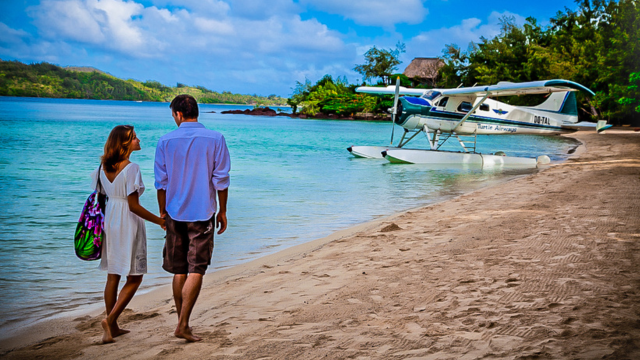
A seaplane takes off and lands on water and can therefore reach resorts that do not have an airstrip or conventional helipad.
- beach-to-beach or water-based access;
- particularly useful Mamanuca and Yasawa connections;
- scenic low-level flying;
- avoiding lengthy ferry journeys;
- access to destinations where land-based aircraft cannot operate.
However, the seaplane may not always land directly outside your resort. Some transfers can use a nearby water landing point followed by a short resort boat connection. Other properties may receive direct water landings when conditions permit.
Which is better?
Neither is universally better. Choose the aircraft that provides the simplest complete transfer to your actual accommodation.
Your next step: Ask your resort exactly how guests arriving by helicopter and seaplane reach reception after landing.

3. Confirm exactly where the aircraft lands
This is one of the most important checks in the entire booking.
Do not assume:
- a helicopter lands directly at the resort;
- a seaplane lands directly on the resort beach;
- the advertised destination name is the physical landing point;
- a boat connection is included;
- someone will automatically be waiting when you land.
- A seaplane transfer may involve Nadi -> water landing -> resort tender -> resort. Some resorts receive direct water arrivals, while others use a nearby transfer point.
Before booking, confirm:
- exact landing location;
- whether the aircraft reaches the resort directly;
- whether another boat or vehicle is required;
- who operates the final transfer;
- whether that transfer is included;
- how luggage moves between aircraft and resort;
- what happens if the normal landing point cannot be used.
Visitor Advisory – “Direct” does not always mean reception: A transfer advertised to your resort may still use a nearby approved landing point followed by a boat, vehicle or resort tender. Confirm the final stage before paying.
Your next step: Get the complete arrival sequence in writing.

4. Check the departure base and airport connection
This is particularly important after an international flight. Different aircraft operators do not necessarily leave from the same place.
Allow for:
- immigration;
- baggage collection;
- customs and biosecurity;
- walking through the terminal;
- meeting your transfer driver;
- road journey to the aircraft base;
- aircraft check-in;
- safety briefing;
- operational waiting time.
Do not build a connection around the scheduled international landing time. Build it around the realistic time you will be outside the airport with your luggage.
Late international arrivals
Air transfers are particularly sensitive to daylight and operating conditions. If your international flight arrives late in the day, your transfer may have to move to the following morning.
That can create:
- an unexpected Nadi hotel night;
- additional airport transfers;
- a lost prepaid resort night;
- an altered meal plan;
- a shortened island stay.
Your next step: Give the air operator your international flight number and scheduled arrival time before confirming the transfer.

5. Treat flight times as operational, not guaranteed
Aircraft transfers are fast, but they are not immune from delays. Flights can be affected by:
- visibility;
- cloud;
- wind;
- thunderstorms;
- sea conditions at a seaplane landing area;
- operational aircraft requirements;
- passenger connections;
- daylight;
- landing-site conditions.
A flight advertised at a particular time should therefore be treated as operational transport, not as an immutable railway timetable.
Reconfirm before travel
- current departure time;
- required check-in time;
- pickup time from the airport or hotel;
- weather conditions;
- current landing arrangement;
- return departure;
- what happens if the flight cannot operate.
Do not create a fragile international connection
The return journey deserves an especially generous margin. A scenic short flight is only useful if it actually gets you to Nadi comfortably before your international departure.
Visitor Advisory – Weather recovery matters: Before paying, ask what happens if weather prevents your flight. Find out whether the operator reschedules, refunds, arranges an alternative transfer or leaves the traveller to organise another route.
Your next step: Understand the disruption plan before you need it.
6. Confirm the complete fare and booking conditions
Air transfers are usually a premium transport choice, so compare more than the headline fare. Ask whether the quoted amount includes:
- one-way or return travel;
- taxes and charges;
- airport or hotel transfers;
- final resort boat transfer;
- child fare;
- infant travel;
- excess luggage;
- private charter supplement;
- minimum passenger requirement;
- inter-island transfer;
- cancellation or amendment fees.
Minimum passenger numbers
Small-aircraft services can depend on minimum passenger numbers. This matters particularly for solo travellers. A flight being available online does not necessarily mean one passenger can automatically confirm it.
Scheduled seat or private charter?
Ask whether you are buying a seat on a scheduled/shared service or the complete aircraft as a charter. The distinction can dramatically affect price and flexibility.
Your next step: Compare the complete confirmed price for your exact date, number of passengers and luggage – not an advertised “from” fare.
7. Plan luggage, passenger weights and specialist equipment
This is where an air transfer can become less convenient than a ferry. Small helicopters and seaplanes have strict weight and space limitations.
Always declare before payment:
- checked suitcase;
- cabin bag;
- large backpacks;
- surfboards;
- dive equipment;
- fishing rods;
- golf clubs;
- prams;
- wheelchairs;
- mobility equipment;
- medical equipment;
- unusually heavy or oversized bags.
- Do not assume an international airline baggage allowance applies to a Fiji resort aircraft.
Passenger weights
Small-aircraft loading calculations may require individual passenger weights. Provide accurate information when requested. This is an operational requirement, not a judgement about the passenger.
Divide your luggage intelligently
If your air-transfer allowance is smaller than your international allowance, consider:
- taking a smaller island bag;
- storing unnecessary luggage in Nadi where suitable arrangements exist;
- sending additional luggage by another approved transfer;
- checking whether the resort can assist.
- Do not simply arrive with excess luggage and assume it will travel.
Your next step: Send the operator the number, approximate size and weight of every bag before confirming the booking.

8. Understand boarding, children and mobility requirements
Small-aircraft transfers are different from boarding a commercial jet. Travellers may encounter:
- steps;
- narrow doors;
- uneven ground;
- beach or pontoon boarding;
- aircraft skids;
- small cabins;
- limited headroom;
- boat-to-seaplane transfers;
- noise and rotor wash around helicopters.
Families
Ask about:
- infant seating;
- child fares;
- minimum ages if applicable;
- child restraints;
- prams and pushchairs;
- luggage allowance for infants;
- whether children require their own seat.
Mobility
Travellers with restricted mobility should ask for an exact description of the journey. Do not accept a vague “yes, we can take you” without understanding the physical transfer.
Instead ask:
- Are there steps?
- Can the passenger walk unaided to the aircraft?
- Is boarding from a beach, pontoon or helipad?
- Is wheelchair transfer assistance available?
- Can mobility equipment travel in the aircraft?
- Is there a boat connection after landing?
- Who physically assists the traveller?
Visitor Advisory — Confirm physical assistance in advance: Boarding may involve steps, uneven surfaces, beaches, pontoons, boats or rotor wash. Ask who will provide assistance and whether mobility equipment can be carried before paying.
Your next step: If mobility is relevant, describe exactly what assistance is needed before paying.
9. Know when an air transfer is not the best choice
Seaplanes and helicopters can be exceptional, but they are not automatically superior.
Situation | Usually worth considering |
Tight same-day resort connection | Air transfer |
Long marine journey | Air transfer |
Very limited holiday time | Air transfer |
Traveller prone to seasickness | Air transfer |
Heavy luggage | Ferry or other suitable service |
Large family or group | Compare complete group cost carefully |
Late international arrival | Overnight + next-day transfer may be necessary |
Weather-sensitive itinerary | Build substantial contingency |
Traveller uncomfortable with small aircraft | Ferry or conventional flight |
Resort has excellent scheduled ferry service | Ferry may offer better overall value |
International departure immediately after island transfer | Earlier transfer or previous-night mainland stay |
Do not pay only for the photograph. The aerial view may be extraordinary, but transport still has to function as transport. Choose the air transfer when it solves a genuine journey problem or when the experience itself is worth the additional cost to you.
Fiji Journal Local Perspective: The most expensive option is not automatically the best Fiji journey. Sometimes the ferry is part of the holiday. Sometimes several hours on a boat wastes half a precious day. The right answer depends on your particular itinerary.
Your next step: Compare time saved, complete cost, luggage convenience and disruption risk together.
10. Protect the return journey
The return flight deserves more attention than the outbound flight. On arrival in Fiji, a delayed island transfer is frustrating. On departure day, it can mean missing an international flight.
Confirm:
- island pickup point;
- pickup time;
- aircraft departure time;
- expected Nadi arrival;
- onward airport transfer;
- international check-in requirement;
- weather contingency;
- alternative boat or ferry;
- refund or rebooking rules.
Consider returning to Nadi the previous day
This becomes increasingly sensible when:
- your international flight departs early;
- you are travelling during unsettled weather;
- the island is remote;
- there is only one practical transfer;
- missing the international flight would be expensive;
- your travel insurance requires reasonable connection planning.
A final mainland night can feel less exciting than another night on an island, but it can remove a major point of failure.
Visitor Advisory – Do not build the shortest theoretically possible connection: Use a substantial margin before an international departure. Weather, operational requirements and transfers between bases can all affect the real arrival time.
Your next step: Plan the return before you book the outbound transfer.
